Arabic gum from Chad: supplier, price, wholesale purchase and supply strategy for industrialists
Arabic gum is today a strategic raw material for industrialists. Used as a natural stabilizer (E414), it intervenes in the formulation of many food, pharmaceutical and cosmetic products. Behind this discrete ingredient is a major issue: securing reliable supply in an unstable global market, heavily dependent on Africa.
In a context of tensions on natural raw materials, arabic gum is a product of high strategic value. Industrialists no longer seek only one product, but a partner able to guarantee continuity of supply, quality and logistical control.
✔ Wholesale purchase arabic gum
✔ Export Africa – Europe under control
✔ Secure procurement
The global market for arabic gum: a structural dependence
World production of arabic gum is more than 90% concentrated in the Sahelian band. This particularity makes the sector extremely dependent on climatic and geographical conditions.
The main producing countries are Sudan, Chad and Nigeria. This concentration limits alternatives and exposes industrialists to supply risks.
Climate variations can lead to significant fluctuations in available volumes. A bad season can cause resource scarcity and a significant price increase.
Why Arabic gum is a strategic issue for industrialists
Unlike other raw materials, arabic gum cannot be produced artificially on a large scale. It depends on specific natural ecosystems.
This dependency creates structural market instability. For industrialists, this means that product availability can directly impact production.
Disruption of supply may result in:
- stop production
- modification of formulations
- increased costs
- loss of competitiveness
Chad: a key source for securing supplies
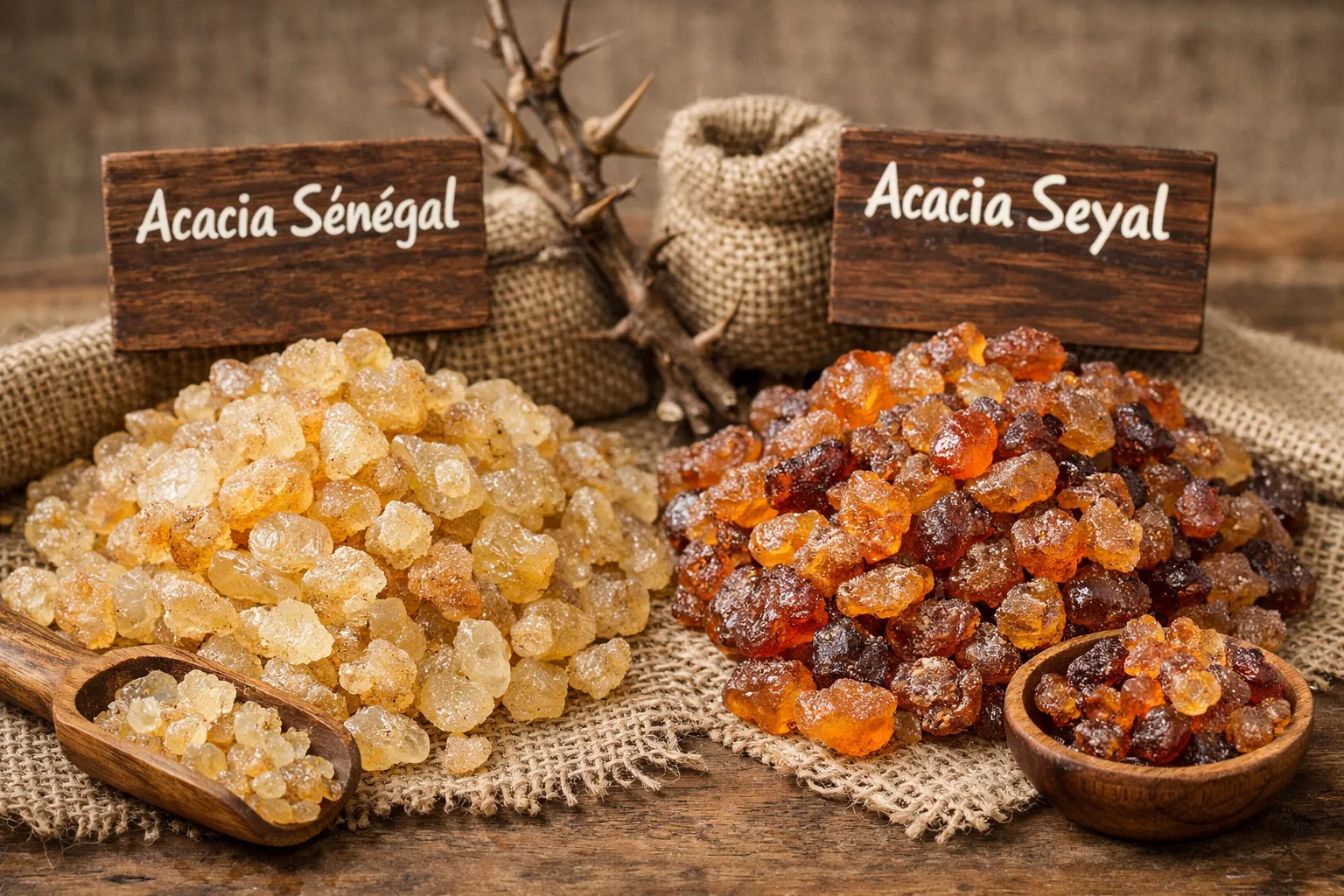
Chad is now a major player in the world market for Arabic gum. Its production is mainly from the Acacia senegal, recognized for its superior quality.
Working with a supplier based in Chad provides direct access to the resource and limits intermediaries.
→ Access the Arabic gum from Chad
Technological functions of arabic gum
Arabic gum is used for its functional properties:
- stabilisation of systems
- emulsification
- improved texture
- microencapsulation
This versatility makes it an essential ingredient in many industrial formulations.
Prices of Arabic gum: understand the mechanisms
The price of arabic gum is influenced by several factors: quality, volumes, climatic conditions and logistics.
This variability requires manufacturers to adopt a purchasing strategy based on secure flows rather than price alone.
Buying Arabic gum wholesale: structure your strategy
Wholesale shopping is essential for industrialists. It requires a rigorous organization and a supplier capable of ensuring continuity.
- constant volumes
- homogeneous quality
- complete traceability
- controlled logistics
Logistics and export: a key performance factor
The export of arabic gum to Europe requires a rigorous logistical organization. Transport, customs and deadlines must be controlled.
Comparison supplier: strategic analysis
| Criteria | Unstructured | Structured | Impact |
|---|---|---|---|
| Quality | Variable | Stable | Production stability |
| Volumes | Unstable | Secured | Continuity |
| Prices | Volatil | Optimized | Cost control |
| Logistics | Complex | Controlled | Reliable deadlines |
| Risk | High | Low | Industrial security |
Optimization of multi-product sourcing
FAQ – Arabic gum
What is the price of arabic gum?
Price depends on market, volume and quality.
Where to buy arabic gum?
At a specialist supplier.
Why choose Chad?
Quality and availability.
Can we buy in bulk?
Yes.
How to secure its supply?
With a structured supplier.
Which sectors use arabic gum?
Food, pharma, cosmetics.
Why is the market unstable?
Climate conditions.
Can we import into Europe?
Yes.
Which quality?
Acacia Senegal.
What is the supplier's role?
Ensure volumes and quality.
Conclusion
Expanding your knowledge and formulations
Access our resources and discover the natural raw materials adapted to your cosmetic projects, including kinkeliba and other ingredients from Chad.